




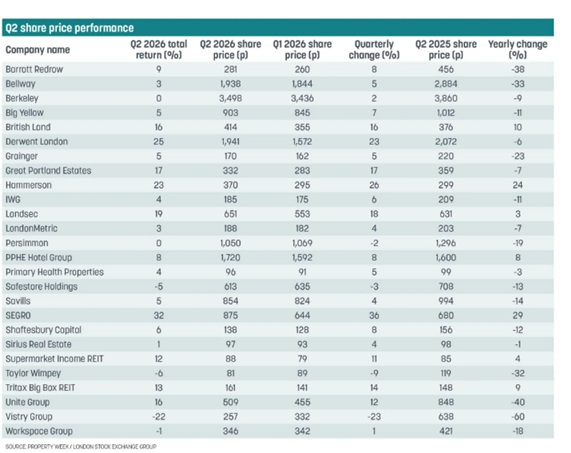
The share prices of the 26 FTSE 100- and FTSE 250-listed property firms monitored quarterly by Property Week rose 8% in Q2 compared with the previous quarter, but were still down 13% on average year on year.
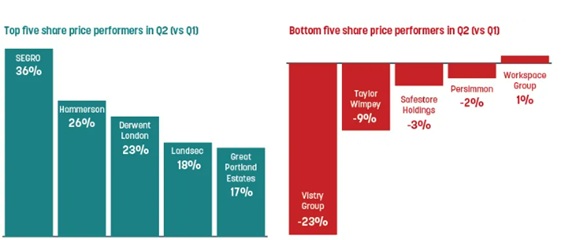
Industrial and logistics giant SEGRO, which is the UK’s largest property company, experienced the biggest share price boost, at 36%, in the three months to the end of June, and was up 29% year on year.
Ahead of California-based Prologis’s £14bn bid for SEGRO, which the UK REIT’s board announced it would recommend to shareholders as Property Week went to press, Oli Creasey, head of property research at Quilter Cheviot, described the approach as “massive for SEGRO and its shareholders”.
On 22 July, Prologis submitted a best and final offer for SEGRO, valuing the UK REIT at circa £14bn, around 1,031.7p per share. The non-negotiable proposal consists of 0.0920 new Prologis shares for each SEGRO share. SEGRO’s share price rose 4.19% after the announcement.
This final offer follows three previous Prologis proposals SEGRO had rejected. During Q2, in June, SEGRO vetoed an approach valuing the company at £12.6bn. Prologis subsequently submitted an improved proposal equating to 993p per share, valuing SEGRO at £13.5bn, which also included a cash component and a commitment to explore the possibility of a secondary listing on the London Stock Exchange – but this was also rejected.
Prologis has recently revealed that SEGRO also rejected a previous offer in 2024, which it claimed would have made shareholders 36.5% better off than today.
SEGRO has a market cap of around £12bn and a portfolio value of £19.1bn, compared with the sector average of £5.8bn, according to Property Week analysis of UK REIT balance sheets.
While there has been a wave of mergers and acquisitions in the UK REIT sector over the past few years, these deals were focused at the lower end of the market.
Creasey says: “SEGRO is the biggest REIT in the UK however you measure it, and we always worked on the assumption that a company of that size and complexity would not be a takeover target.” But Prologis’s approach “has upended that assumption”.
Creasey adds that the bid “has got even bigger repercussions” for the wider REIT sector, because “if you look at the top 10 REITs, probably 5% to 10% of [their Q2 share price rise] came on the morning of the [June] SEGRO bid, when everyone had to adjust their assumptions and go ‘hang on, if SEGRO can be bought, then Derwent, Landsec and British Land can be bought’”.
This may help explain the 26% share price rise for Hammerson during Q2, while Derwent London’s shares rose 23%, Landsec’s by 18% and Great Portland Estates’ by 17%.
The worst share price performers
The Prologis bid may have boosted some of the property firms monitored by Property Week, but housebuilders did not share this good fortune, performing poorly during Q2. Among the five worst share price performers were Vistry, Taylor Wimpey and Persimmon, down 23%, 9% and 2% respectively.
Taking a wider view of the bottom five on an annual basis, four of them are housebuilders, with Vistry slumping 60% year on year, Barratt Redrow down 38%, Bellway losing 33% and Taylor Wimpey dropping 32%.
Alastair Stewart, an analyst at Progressive Equity Research, believes continuing economic uncertainty due to political instability, the war in Ukraine and the US-Israeli conflict with Iran mean “the market for housebuilders has slowed significantly”.
He adds that Labour’s first Budget in 2024 caused concern and there was much speculation ahead of its second, 2025 Budget: “There was a definite slowdown in advance of that, even if it didn’t turn out to be that bad for the market. It turns out the second Budget was OK from a housing perspective, and so the market picked up fairly well immediately after it.” However, the outbreak of conflict in the Middle East soon choked off that recovery.
Creasey concurs that housebuilders in general are “having a nightmare”. He adds that “it has to be acknowledged that the biggest mover is Vistry by some margin”, but notes that this is down to conditions specific to that company, rather than just a general market downturn.
“We’re not going to pretend to know exactly what’s going on behind closed doors at Vistry, but it feels a little bit desperate at times,” Creasey says.
Noting that the firm is selling houses in volumes greater than would normally be expected, he adds: “The implication is they’re selling them at a slightly cut price and valuing cashflow over profitability. That’s always going to raise questions about the balance sheet and its strength.”
According to Creasey, Vistry shareholders have clearly reacted negatively to the company’s strategy and performance – and that negativity may have percolated through the rest of the sector to some degree.
Meanwhile, Taylor Wimpey, the second-biggest share price faller among housebuilders in Q2, has spoken of price pressures on its assets and the fact the South East market is not particularly strong.
However, according to Creasey, there are “no dramas” at the likes of Barratt Redrow, Persimmon, Berkeley Homes and Bellway, which “were all basically flat during the quarter”.
Stewart adds that housebuilders have faced other issues, including bad weather. “Let’s not forget the period of torrential rain in January and February, and that’s not conducive to housebuilding at all,” he says.
He also points to continuing political upheaval as the UK’s seventh prime minister in 10 years settles into Downing Street. “Under these circumstances, consumers put things on hold a bit,” he says. “Basically, everything that could go wrong for housebuilders has gone wrong over the past few years.”
Housebuilders will be hoping that Andy Burnham, the latest PM to promise hope and change, can deliver. For other REITs, it appears that the bid for SEGRO has changed the rules of the game and all of them could be a target for bigger rivals from overseas.
 Trident home
 Follow us on LinkedIn