




A sharp fall in new-build sales rates has left the smallest housebuilders in the country fighting for survival, Savills and the Land, Planning and Development Federation (LPDF) have warned.
A report titled ‘Land Matters: Removing Barriers to Housebuilding’ reveals that sales rates have fallen most sharply for the smallest firms, those delivering fewer than 50 homes a year, dropping as low as 0.15 to 0.25 sales per outlet each week in 2025.
This translates to a site now selling only around 10 homes a year, which has an impact on delayed cash receipts, driving up interest costs and eroding the margins on which smaller developers depend.
Set against rising build costs, the study warns that these conditions are making survival increasingly difficult for the housebuilding companies that the government is relying on to meet its housing targets.
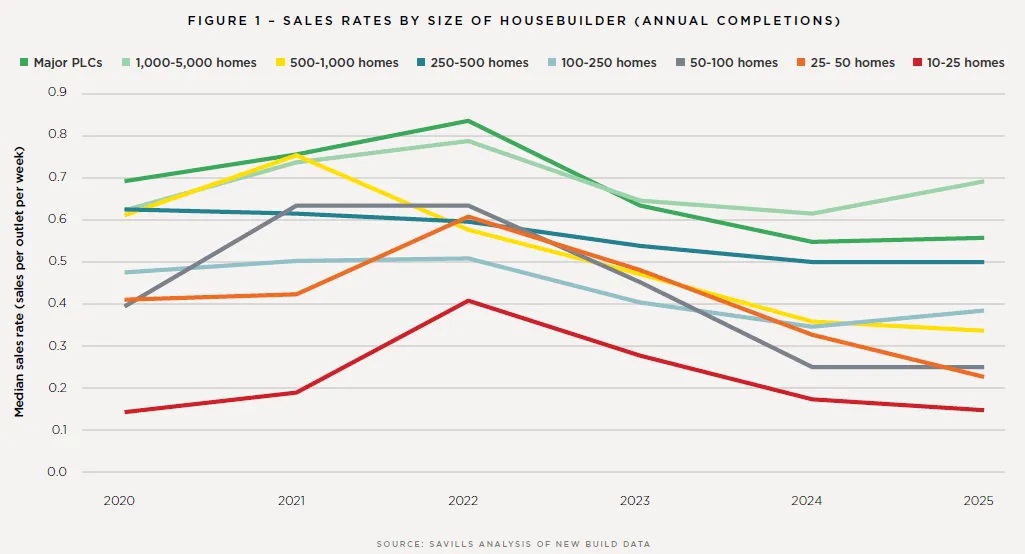
Sales rates by size of housebuilder (Annual completion)
Meanwhile, firms delivering between 250 and 1,000 homes a year achieved sales rates of only 0.4 to 0.5 per outlet each week last year, down from around 0.6 and above in 2022. Below that threshold, no group exceeded 0.4, and some of the smallest firms saw rates fall to around 0.25 or lower.
The pressure is greatest in the South East, where affordability is most stretched and SME sales rates have fallen to levels that threaten the commercial viability of housebuilding.
Additionally, according to a report by built environment data analytics company the Building Cost Information Service (BCIS), since September 2022, average house prices across England have risen by less than 1%, while construction costs have increased by 14% and developers are facing a growing set of regulatory and tax costs, including the Future Homes Standard, biodiversity net gain regulations, the building safety levy and a higher landfill tax.
Savills’ analysis shows that profit on a typical three-bedroom home has fallen to around 13% of gross development value, below the 20% margin developers usually require to take on risk.
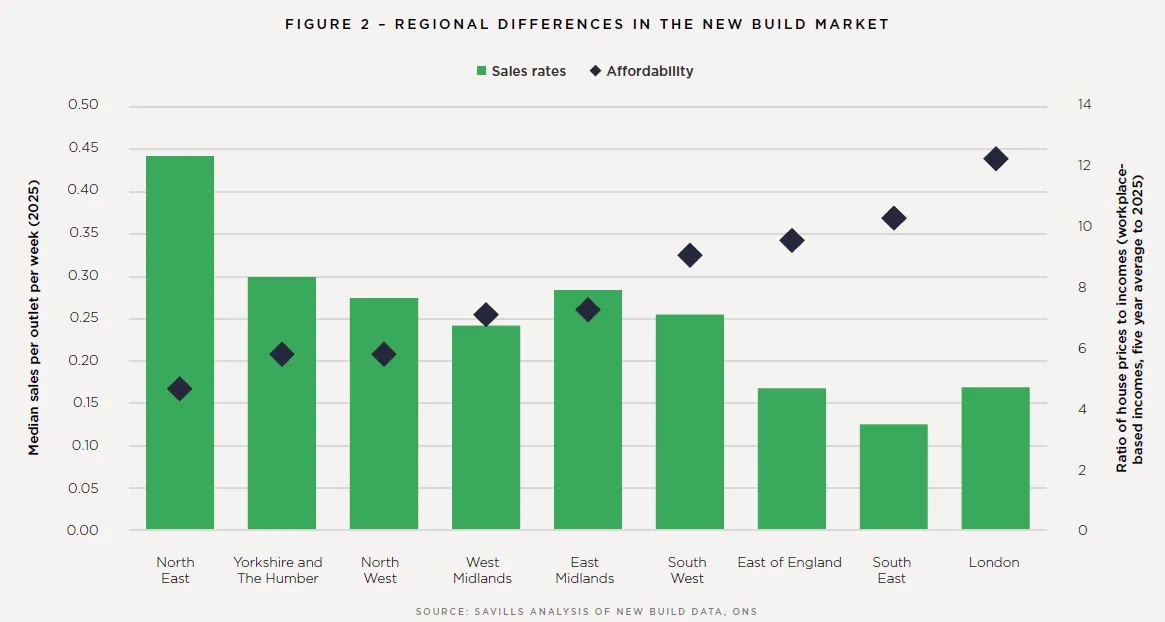
Regional differences in the new build market
Finally, while SMEs delivered around 40% of new homes in the 1980s, today they account for less than 10% of the development pipeline.
As a result, the LPDF has warned that without action to restore demand and improve viability, the recent gains from planning reform are at risk of being undone. The firm has urged the government to:
- Confirm and strengthen the new small and medium-sized sites category in the forthcoming National Planning Policy Framework (NPPF) without delay, giving smaller firms a clear and reliable pipeline of deliverable sites;
- Introduce targeted demand support, including an equity loan scheme for first-time buyers, which research suggests could support up to 85,000 additional homes and add nearly £24bn to GDP by March 2029;
- Allow greater flexibility on Section 106 agreements, including cascade mechanisms, wider acceptance of Discounted Market Sale as a tenure and temporary grant funding to part-fund obligations, to unlock stalled sites and bring affordable homes forward; and
- Expand the National Housing Bank’s lending products for SMEs and provide upfront infrastructure funding to ease the cashflow and viability pressures holding sites back.
Samuel Stafford, managing director at the LPDF, said: “The government is right to be ambitious on housing, and right to reform the planning system. It should hold its nerve and stay the course. But planning reform on its own will not build a single home if the builders are not there to deliver it.
“The market has turned hardest against the smallest firms, and at current sales rates too many are selling barely 10 homes a year on a site while their costs keep climbing, and that is not a sustainable position for a sector we are relying on to help deliver hundreds of thousands of new homes.
“The country needs more builders, not fewer. Put the demand and viability measures set out in this report in place alongside the planning reforms already under way, and we can keep these firms in the market and get Britain building. Fail to, and we risk losing the very capacity the government’s targets depend on.”
Hamish Simmie, associate director at Savills Research, added: “These funding and policy changes would have a material impact on the capacity of SME housebuilders and land promoters to operate in the market. Successful implementation of these changes will improve the consistency and availability of buyers for land and new homes.
“This will not only remove barriers to delivery of the 1.1 million plots controlled by these operators, but also unlock activity across the planning and development process, stopping or reversing the decline in housebuilding. Without this support, we risk a continued decline for the SME sector.”
 Trident home
 Follow us on LinkedIn