




Housebuilders have bucked the Q3 trend, outperforming the market against a backdrop of a lacklustre listed property share price performance.
Biggest quarterly risers and fallers (%)
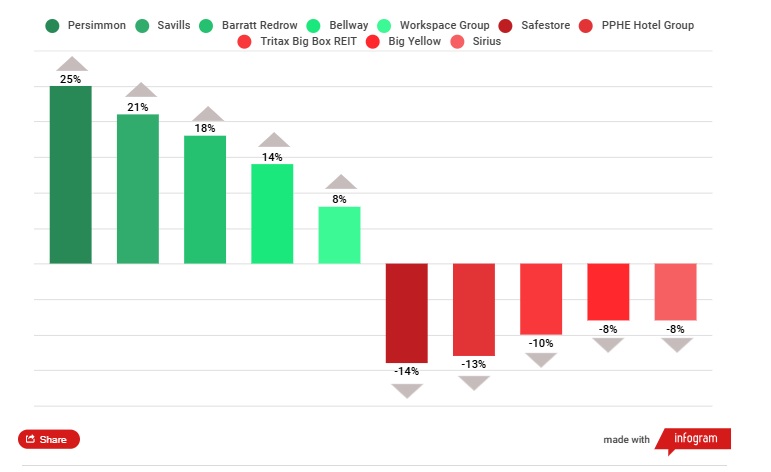
Persimmon, Barratt Redrow and Bellway all posted double-digit share price growth in the three months to 30 September 2026 compared with the previous quarter. This compares to overall average share prices that were flat on a quarterly basis and down 8% year on year.
Housebuilders were four of the top six best share price performers quarter on quarter, Property Week’s analysis of selected property stocks across the FTSE 100 and 250 shows.
The announcement just prior to the Labour Party conference of the Your First Home programme to help first-time buyers in England gave housebuilders a share price boost just as the quarter was closing. Their share prices subsequently settled amid unanswered questions about the scheme, including its start date, how much funding it would be allocated and the level of developer contributions.
Top performer Persimmon had the biggest share price boost, up 25% on Q2, and up 8% on the previous year. Oli Creasey, head of property research at Quilter Cheviot, says the company had a lot of exposure to the previous Help to Buy scheme, so “the assumption is that if anyone stands to gain from it, it’s them”.
Investec equity analyst Aynsley Lammin believes the policy’s positive impact was not the only factor underpinning Persimmon’s share price performance: “They’ve got the lowest average selling price; they’re opening sites and doing lots of very positive things internally.” Persimmon’s results for the six months to 30 June showed completions up 13% on H1 2025. Underlying operating profit rose 10% to £189.1m.
Andrew Saunders, equity analyst at Shore Capital, believes Persimmon’s success also marks a move away from the obsession with net asset value (NAV). “The problem with NAV is that management teams have no control over bond yields [that affect NAV]. Instead, more investors are looking at earnings and dividends and management’s ability to control the controllables.”
Meanwhile, Berkeley failed to capitalise on the Your First Home boost, with analysts speculating that the London-centric nature of its business made it less likely to benefit from the scheme, which many expect to have a big impact in the regions. At the end of Q3, its share price was 4% down on the previous quarter.
Fellow housebuilder Vistry is still reeling from a series of major profit warnings, a massive first-half pre-tax loss and a downgrade to its full-year cash and profit outlooks, prompting a probe into two of its former accountants by accountancy regulator the Financial Reporting Council. Vistry’s Q3 share price was flat compared with Q2 and down 59% year on year.
A pivot in Vistry’s business model to social housing has failed to resonate with the markets. While private sales remain part of the mix, its partnership model specialises in providing affordable housing by teaming up with councils and housing associations.
In August, Vistry secured £350m in funding as part of the government’s £39bn Social and Affordable Homes Programme, but share price recovery and renewed confidence in the business have yet to materialise.
Acquisition boost for Savills
Elsewhere, Savills’ share price rose 21% quarter on quarter and 9% year on year, buoyed by its acquisition of specialist real estate investment bank Eastdil Secured. “Savills has been lacking global reach; this acquisition gives them a line into managing big equity M&A deals and it looks like the markets have given them a reward for it,” Creasey says.
Meanwhile, industrial and logistics giant SEGRO’s share price continued to benefit from the £14.3bn takeover bid by Prologis after its shareholders voted overwhelmingly in favour of the deal at the end of Q3. Subject to approval by the Competition and Markets Authority, the deal is expected to be completed in the first half of 2027. SEGRO’s share price was up 6% on Q2, despite single-digit falls across many REITs, and up 39% year on year.
Q3 share price performance
Infogram
Another stand-out performer year on year is Hammerson, up 18% as its shopping centre market foothold pays dividends after a decade in the doldrums. Creasey says: “The shopping centre story is one of big recovery. The past 10 years were abysmal for shopping centre landlords, but it feels like that destruction of value has finished. It’s taken a few years to make shopping centres fit for purpose. However, collectively, the industry is through that bad time now and has got itself on an even keel.”
The self-storage sector was less buoyant, with Safestore’s share price down 14% on Q2 and 23% year on year, against a backdrop of a subdued Q3 housing market. Shares at Big Yellow were also down by 8%.
“Both companies are quite geared to the housing market, so are very much a proxy for house move volumes. That’s happening less, and that’s impacting the business,” Creasey says. “Safestore is a bit more London and South East orientated. They’ve also got Paris exposure, and that isn’t a great place to be doing business right now either.”
Bond yields hit property pricing
As for the broader market outlook, the rise in government bond yields since the start of the war in Iran has caused a change in pricing expectations from investors for real estate valuations. Andy Burnham’s appointment as prime minister, alongside Cabinet changes, caused bond yields to spike in Q3.
“Bond markets are quite nervous that the first Budget under Burnham might require more debt and more government bonds to pay for it,” says Saunders, speaking ahead of the event.
A lot hinges on the Budget, how the changes will be financed and whether additional government borrowing will be needed, Saunders believes. “The chancellor is a little bit hamstrung by Labour’s manifesto promises not to raise taxes and this is what the markets are nervous about,” he says.
Budget uncertainty aside, Lammin says a bigger issue is rising mortgage and swap rates. “That’s impacting affordability and confidence, which is holding the market back.”
Despite indications that the property sector is on the up after bottoming out in Q2, investor confidence in a dramatic recovery is at best muted, against a backdrop of rising interest rates, bills and inflation.
“The sector is still earning a suboptimal return on capital employed, so the backdrop remains very difficult,” Lammin says. “Investors want a bit more evidence that we’re actually seeing a recovery and the next big catalyst for that is probably the spring selling season.”
 Trident home
 Follow us on LinkedIn