




Unveiled by the government last January as part of its AI Opportunities Action Plan, AI Growth Zones (AIGZs) recognise the need to speed up data centre development to enable the UK to maximise opportunities from its position as the world’s third-largest AI market.
The plan notes: “As AI infrastructure providers seek access to land and power, governments who move quickly and mirror the pace of growth and innovation in the AI data centre market will be best placed to secure investment.”
According to the action plan, AIGZs could introduce a streamlined planning approvals process and accelerate the provision of clean power, enabling a major opportunity to draw in private capital.
But despite this political momentum, freedom-of-information (FOI) data analysed by Search Acumen and provided exclusively to Property Week shows there is no development pipeline for AIGZs yet. For the property market, questions remain as to whether AIGZs can be developed within this parliament, given the significant planning and grid constraints they face.
Greg Roberts, data centre sector lead at architecture, engineering and consultancy company Ramboll, says: “Data centres are the foundations of the digital economy, but must be built with a clear purpose in mind, while the needs of the communities they are built in must also be considered.
“That is the logic that underpins the AIGZs policy, but perhaps more could be done to achieve these ends and ensure AI is a facilitator for the digital economy, not just an end in of itself. This will require sustainability to be placed front and centre of any plans.”
The five AIGZ areas
So far, five areas have been announced as AIGZs: Oxfordshire, at Culham Campus; in the North East, at the Cambois Data Centre Campus in Blyth and Cobalt Park in North Tyneside; in North Wales, at Prosperity Parc in Anglesey and the former nuclear power station site at Trawsfynydd; in South Wales, where the former Ford Bridgend Engine Plant is the flagship site; and Lanarkshire in Scotland, where a new data centre campus is planned around DataVita’s existing centre in Airdrie.
These fragmented wins don’t feel aligned with national momentum
Andrew Lloyd, Search Acumen
The sites were selected for their access to large energy capacity, available land often from former industrial sites and potential to host hyperscale data centres.
Rather than Enterprise Zones with tax breaks, these are areas that would receive special consideration for speeding up planning approval, providing priority access to the energy grid and offering a place at the front of the line for private partnerships with major tech firms.
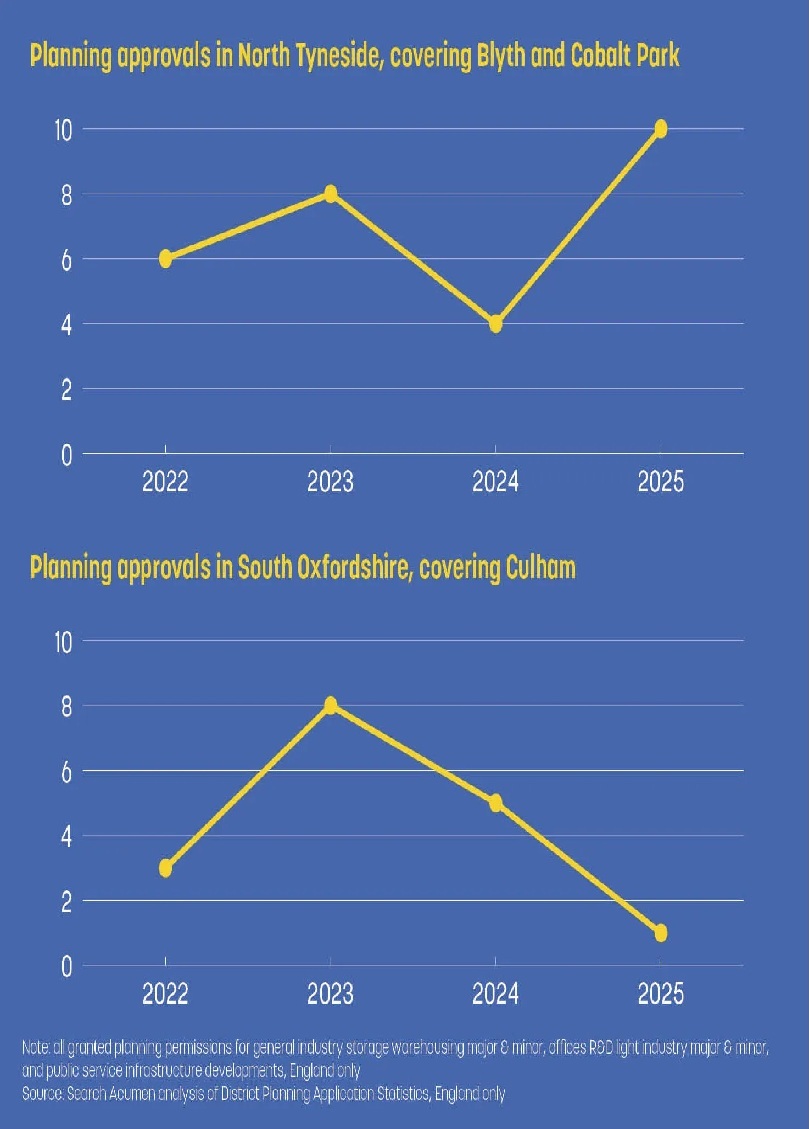
However, Search Acumen’s analysis of district planning for major industry and warehousing, as well as public service infrastructure that includes data storage, reveals a mixed picture in England.
Culham in Oxfordshire was the first area to be announced as an AIGZ last January, but just one planning permission had been granted by the end of that year – way below the 2023 peak, when eight projects were approved. Overall, Culham shows the least progress of all AIGZs in England.
In the year before its status became public, there were some promising wins, such as consent for a ground-mounted solar farm and battery energy storage system (BESS) at Pangbourne Technology Centre, the FOI data reveals. However, the recent slowdown in progress at Culham Campus has been largely attributed to power and grid constraints.
One of the reasons Culham was chosen is that the shutdown of the experimental JET fusion reactor freed up a rare high-capacity grid connection. But scaling up development beyond that has proved difficult.
Across the UK, there are long queues for new power grid connections and even so-called ‘fast-track’ projects still face years of energy and transmission work, according to Search Acumen. “Another major criticism is that the [wider AIGZ] project has political backing, but unclear operational ownership,” says managing director Andrew Lloyd. “Different departments control AI policy – energy, planning permission and infrastructure – which slows execution.”
Southern hot spot: Slough Trading Estate has the world’s second-largest collection of data centres
Credit: Shutterstock / Make more Aerials
Another issue for Culham is its location in a water-stressed part of southern England. Meeting the government’s AI data centre targets may lead to higher water bills and greater water extraction from rivers to support the vast volume of hydropower required.
The picture is similar across other zones. For example, North Tyneside has been inactive since its status was announced in September, despite the highest number of planning approvals for commercial projects across all AIGZs since 2022. Planning consents granted just before the site was given AIGZ status included a BESS scheme and associated infrastructure, according to FOI data.
North Wales was announced as an AIGZ last November. While one AI data centre has since been rejected at the Anglesey chemical factory, another two related projects have been expanded at the Carrog BESS and at an electricity substation at Wylfa, the site for a new small modular reactor (SMR) in partnership with Rolls-Royce SMR.
“These fragmented wins, often occurring before zone announcements, don’t feel aligned with national momentum,” says Lloyd.
Real-world impact
While the zones will potentially be backed by billions in private investment, early evidence of progress and the government’s own metrics on real-world impact remain thin.
For occupiers or developers banking on AIGZ status to de-risk a site or speed up a consent, this data offers no reassurance. “That’s a significant signal for anyone pricing risk on an AI-adjacent development. There are brownfield opportunities, but these remain untested,” says Lloyd.
He adds: “The fact that there are so few AI-related initiatives coming forward within designated zones, with many classified as minor and often still undetermined in planning status, tells you how early-stage the market actually is versus the political narrative on it.”
Roberts adds: “There’s scope for AIGZs to have a positive impact in a relatively fragmented market, but this will require delivery at pace and a forward-looking approach. There is plenty of international competition and AI investment is highly mobile. If the UK does not deliver on the promise of its AIGZs, and quickly, investors will look elsewhere.”
 Trident home
 Follow us on LinkedIn